3D techniques for Cultural Heritage

The Vatican Chapels area recorded with aerial photogrammetry © Oscar Parasiego for Factum Foundation
The interior of Asplund Pavilion recorded with LiDAR © Oscar Parasiego for Factum Foundation
A pointcloud of the Chapel designed by Javier Corvalan © Factum Foundation
LiDAR recording session of Teatro Verde fitting rooms © Oscar Parasiego for Factum Foundation
Pointcloud of Teatro Verde © Factum Foundation
The Entry into Palestine of Vespasian’s Troopspost-processing © Factum Foundation

key details

14 June 2022
Online on Zoom
4pm — 6pm (CET) 

about

The talk brings updates on the project of recording the entire Island of San Giorgio Maggiore in Venice, headquarters of ARCHiVe, and the collections preserved at Fondazione Giorgio Cini.

Carlos Bayod Lucini, project director at Factum Foundation, explains in depth the 3D digitisation of the Teatro Verde and the Vatican Chapels recorded with LiDAR and Photogrammetry.

The Teatro Verde in the woods of Fondazione Giorgio Cini is an open-air theater designed by Luigi Vietti in the 50s and commissioned by Vittorio Cini . The site is currently under restoration and its 3D recording conducted by Factum in 2022 ispart of the project to reopen the theatre to the public in collaboration with Cartier. The talk intends to explain how a detailed 3D documentation can also form part of an architectural site’s restoration and preservation project. 

On the same note, the talk introduces the colour and 3D recording of the surfaces (front and back) of one of the oldest tapestries in the collections of Fondazione Giorgio Cini:The Entry into Palestine of Vespasian’s Troops(1470-1480), in need of restoration.

Lecturer

Carlos Bayod Lucini

He is Project Director at the Factum Foundation. His work is dedicated to the development and application of digital technology to the conservation, study and dissemination of Cultural Heritage. Bayod has taught at the MS in Historic Preservation at Columbia University in New York among other institutions, and is a frequent speaker for centers such as Museo del Prado, Harvard Art Museums and Fondazione Giorgio Cini. 

Portrait of architect Carlos Bayod looking intensely at the camera.

Digital Training, Creativity and Museum Communication. The New Professions for Cultural Heritage

Example of digital exhibition layouts © Cristina Barbiani

key details

23 June 2022
Online on Zoom
4pm — 6pm (CET)

about

Cristina Barbiani, scientific head of the Digital Exhibit Master’s course at the IUAV University of Venice, will introduce the new possibilities of digital technology for the creation of multimedia and interactive systems, combining knowledge and technologies related to ‘computer vision’ and aimed at the creation of museum displays, for design, architecture, multimedia and performing arts.

Lecturer

Cristina Barbiani

She is an architect with a PhD in History of Architecture and the City, Science of the Arts and Restoration at the School of Advanced Studies in Venice. She holds a degree in Design and Production of Visual Arts from the IUAV University of Venice. She is the scientific head of theMaster Digital Exhibit at the IUAVUniversity of Venice. She has a transversal education between architecture and multimedia and performing arts completed by study periods at New York University and MIT in Boston.

Art as a Method of Experimental Preservation

The Ethics of Dust: Doge’s Palaceas exhibited in the Arsenale, 53rd Venice Art Biennale, Jorge Otero-Pailos, 2009
Dirt, Dust and Ruins, exhibition at Tin Sheds Gallery, Sydney, Jorge Otero-Pailos, 2013
The Ethics of Dust, exhibition at the Museum of Yerba Buena, San Francisco, Jorge Otero-Pailos, 2016
Distributed Monuments, latex and dust, Jorge Otero-Pailos, 2022

key details

7 October 2022
Online on Zoom / Onsite at ARCHiVe
2pm — 4pm (CET)

about

This talk discusses Jorge Otero-Pailos’ approach to art as a method of experimental preservation and argues for its relevance in imagining a future for the existing built environment centred on mutual care. Jorge Otero-Pailos draws from a series of recent works in which he employs material residues of buildings and sites – including airborne atmospheric dust, waterways, traces of sweat, and body sounds – to render their invisible meanings visible. In particular, he focuses on hisEthics of Dustseries, explaining how he uses art as a method for the experimental preservation of dust, the kind the atmosphere deposits on buildings. This important historical and environmental record usually goes unrecognized. The artworks inThe Ethics of Dustseries isolate dust and make it tangible by transferring it from the surface of buildings onto translucent casts. Jorge Otero-Pailos also presents a selection of dust casts taken from the Doge’s Palace, Westminster Hall, and other buildings around the world, and discusses the unexpected histories that each of them unveils. He connects the dots between these punctual histories to outline a larger concept they all contribute to, namely that of atmospheric heritage.
The talk is also a presentation of Jorge Otero-Pailos’ bookHistoric Preservation Theory: An Anthology, Readings from the 18th to the 21st Century.

Lecturer

Jorge Otero-Pailos

Director and Professor of Historic Preservation at Columbia University’s Graduate School of Architecture, Planning, and Preservation, he is an architect, artist, and theorist specializing in experimental forms of preservation. His work as an artist has been commissioned by and exhibited at major heritage sites, museums, foundations, and biennials, including Artangel’s public art commission at the UK Parliament, the Venice Art Biennial, Victoria and Albert Museum, Louis Vuitton Galerie Museum, Thyssen-Bornemisza Art Contemporary, SFMoMA, Hong Kong’s Tai Kwun Centre for Heritage and Arts, Frieze London, and the Yerba Buena Center for the Arts

3D Digital Investigation for Canvases and Painted Panels

Colour and 3D rendering ofSan Giorgioby Cosmé Tura at Galleria di Palazzo Cini
Detail of the surface ofThe Crucifixionby the Master of the Lindau Lamentation, courtesy of Museum Catharijne Convent
Printing the colour of the facsimile ofThe Crucifixionby the Master of the Lindau Lamentation © Oak Taylor Smith for Factum Foundation
The Lucida 3D Scanner recordingThe Creation of the Animals© Factum Foundation
RecordingThe Creation of the Animalsby Tintoretto at Gallerie dell'Accademia © Factum Foundation
Handwoven historical patterns recostructions at Factum Foundation

key details

7 and 14 March 2024
Online on Zoom
3pm — 5pm (CET)

about

Online course featuring two projects undertaken by ARCHiVe, alongside other case studies: the digitisation of the Palazzo Cini Gallery (47 panel paintings) and the digitisation of a painting by Jacopo Tintoretto from the collections of the Gallerie dell’Accademia in Venice (The Creation of the Animals, 1550-1553). The course offers a detailed examination of the digital recording of these works and the investigative opportunities afforded solely through the three-dimensional digital recording of painting surfaces and supports.

In addition to unveiling 3D digital acquisition techniques, the meetings are intended as moments of restitution and exchange to disseminate the research possible thanks to this type of technology applied to Cultural Heritage. Therefore, the course shares the outcomes of the reconstruction ofTheCrucifixionby the Master of Lamentation from Lindau in Utrecht and the recreation of historical textile patterns derived from digital analyses of pictorial surfaces on both panel and canvas.

Programme

Class 1March 7, 2024

Painting on panel

  • Luca Massimo Barbero | Fondazione Giorgio Cini
  • Sanne Frequin | University of Utrecht
  • Carlos Bayod Lucini | Factum Foundation

Two case studies compared: the three-dimensional recording of panel paintings in the Gallery of Palazzo Cini in Venice and the reconstruction ofTheCrucifixionby the Master of Lamentation of Lindau in Utrecht.


On this occasion the results of the first three-dimensional, high-resolution digitisation campaign of the painted panels in Palazzo Cini, carried out by the Factum Foundation in collaboration with the Cini Foundation, will be presented. The campaign is part of the activities promoted by the Foundation to preserve, publicise and make the collections more accessible.

Next, the results of a project to digitise, digitally restore and rematerialise a panel work from the first half of the 15th century, theCrucifixionby the Master of Lamentation of Lindau, the result of a collaboration between Factum Foundation, Museum Catharijne Convent, Utrecht University, Leiden University and Technische Universiteit Delft. The project intends to demonstrate how digital technologies and facsimile production can be part of the decision-making process in the field of conservation, becoming a possible alternative to physical intervention on the objects.

Class 2March 14, 2024

Painting on canvas

  • Cleo Nisse | University of Groeningen
  • Helena Loermans | Lab O
  • Carlos Bayod Lucini | Factum Foundation

The analysis and creation of historical textile patterns and the digitisation of Tintoretto’sThe Creation of Animalsas case studies.


The second appointment, dedicated to paintings on canvas and the micro-analysis of the supports, sees the participation of a weaver specialised in the manual creation of historical textile patterns to support technical art history (particularly Italian and Spanish between the 15th and 17th centuries) to present a recent rematerialisation project made possible thanks to the digital acquisition of the original supports. This will be followed by a researcher who focuses her investigations precisely on canvas supports in relation to the pictorial language of Venetian works from Bellini to Tintoretto. In both cases, the aim is to demonstrate how this type of micrometric investigation can now be carried out more comprehensively thanks to high-resolution three-dimensional digital surveys.

lecturers

luca massimo barbero

Historian and critic of modern and contemporary art, he is Director of the Institute of Art History at the Fondazione Giorgio Cini in Venice, and scientific advisor to the Lucio Fontana Foundation in Milan.He is the author of numerous publications and exhibitions on the art of the Italian post World War II period.

sanne frequin

She is an art historian who specialises in digital art history. Her research focuses on the digital reconstruction of lost or damaged artefacts and on the use of digitised artefacts for research and education. The projects of Sanne Frequin concern mediaeval and early modern art and digital reconstruction.Sanne Frequin is the academic coordinator of the master Art History at Utrecht University.

A portrait of professor Sanne Frequin. A woman wearing glasses smiles at the camera with confidence.

carlos bayod lucini

He is Project Director at the Factum Foundation. His work is dedicated to the development and application of digital technology to the conservation, study and dissemination of Cultural Heritage. Bayod has taught at the MS in Historic Preservation at Columbia University in New York among other institutions, and is a frequent speaker for centers such as Museo del Prado, Harvard Art Museums and Fondazione Giorgio Cini. 

Portrait of architect Carlos Bayod looking intensely at the camera.

cleo nisse

She is Assistant Professor of Early Modern European Art at the University of Groningen. Her research concentrates on the materials, techniques, and meanings of artistic practices, complemented by a concern for how artworks change over time. After postgraduate studies in painting conservation at the Courtauld Institute, her Columbia University PhD investigated the significance of canvas supports for Venetian painting from Bellini to Tintoretto.

A portrait of professor Cleo Nisse smiling at the camera immersed in the nature.

helena loermans

She has been a weaver since 1960. Now a member of CIETA, in 2017 she founded Lab O, a research laboratory focusing on the hand-woven patterned canvases used by the Spanish and Italian Old Masters. Photomicrographs, x-ray images, 3D recordings and softwares for generating weave drafts, allowed Loermans at Lab O, to reconstruct the weave drafts of patterns in Old Master paintings’ canvases and reweave the textiles on a hand loom.

Portrait of the weaver Helena Loermans. A mature woman posing in front of the camera showing confidence and a smiling face. She is wearing a bright yellow tunic and flamboyant necklaces.
1/2 3D Digital Investigation for Canvases and Painted Panels

Computational Museology: Cultural Heritage and the Digital Museum

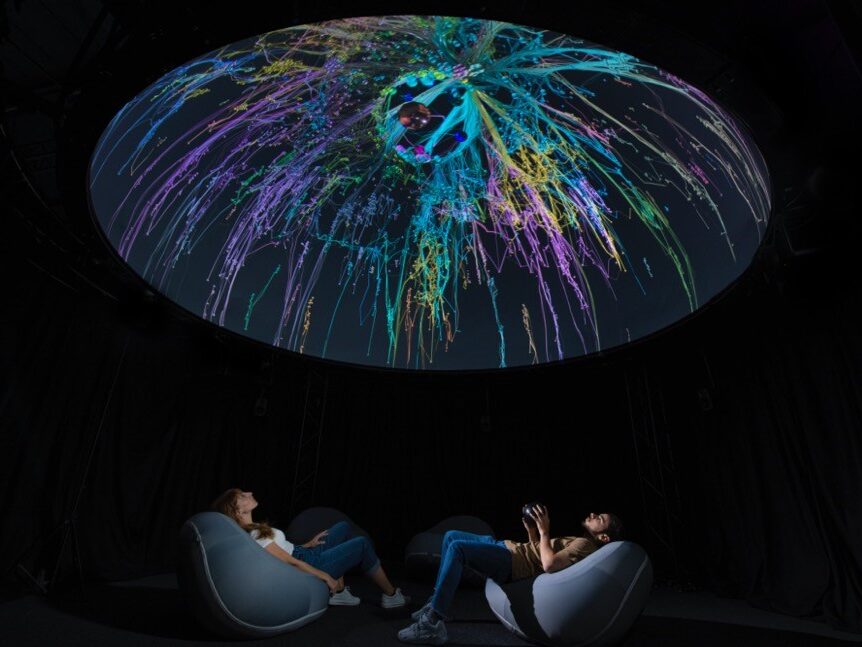
Double Truth, Sarah Kenderdine, 2021
Jazz Luminaries, Montreux Jazz Digital Archive, Sarah Kenderdine, Andrew Quinn, Davide Santini, Kirell Benzi, 2019
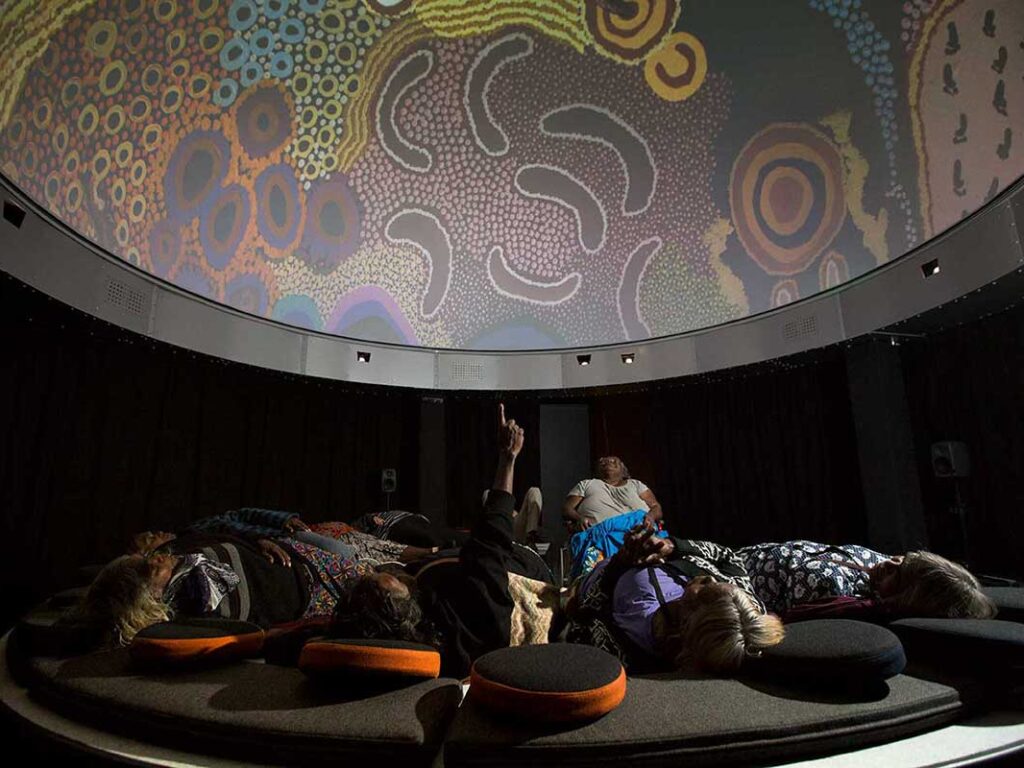
Travelling Kungkarangkalpa, Sarah Kenderdine, Peter Morse, Cedric Maridet, 2017
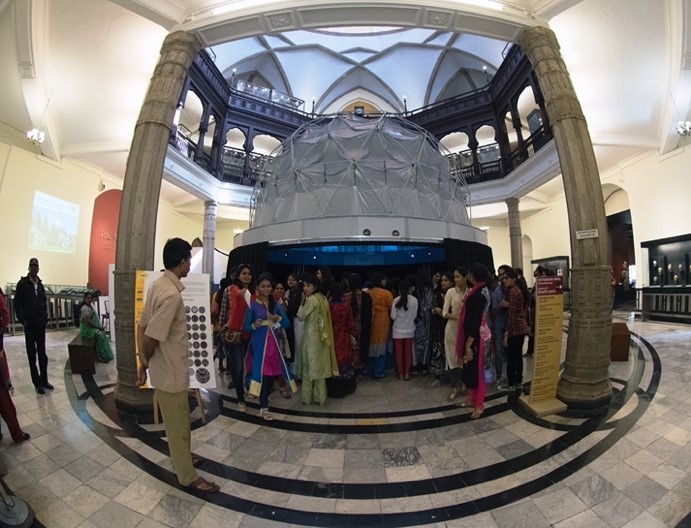
Look Up Mumbai, Sarah Kenderdine and Jeffrey Shaw, 2015

key details

4 April 2024
Online on Zoom
3pm — 5pm (CET)

About

Computational museology is a scaffold that unites machine intelligence with data curation, ontology with visualisation, and communities of publics and practitioners with embodied participation through kinaesthetic interfaces. Computational museology empowers cultural organisations to link all forms of culture and materiality: objects, knowledge systems, representation and participation. Research at theLaboratory for Experimental Museology(eM+) reaches beyond object-oriented curation to blend experimental curatorship with contemporary aesthetics, digital humanism and emerging technologies.

This lecture curated bySarah Kenderdineexplores key themes including interactive archives and emergent narrative, deep fakes and blockchain sovereignties, embodied knowledge systems and performative interfaces and scientific visualisation for museums in the age of experience. She will also give an overview of EPFL Pavilions exhibitions and focus the discussion onDeep Fakes: Art and Its Double.

Lecturer

Sarah Kenderdine

She researches at the forefront of interactive and immersive experiences for galleries, libraries, archives and museums. In 2017, Sarah was appointed professor at the École Polytechnique Fédérale de Lausanne (EPFL), Switzerland where she has built the Laboratory for Experimental Museology (eM+). Sarah is also director and lead curator of EPFL Pavilions a new art/science initiative. In 2020 and 2022, she was named in the top 10 of theMuseum Influencer Listby Blooloop and in 2020 and 2021,Switzerland’s Top 100 Digital Shapersby Bilanz. In 2021, Sarah was appointed corresponding fellow of The British Academy. Her upcoming book isDeep Fakes: A Critical Lexicon of Digital Museology(2024).

Digitisation and valorisation of Venetian Music Archives

© Fondazione Giorgio Cini
© Fondazione Ugo e Olga Levi

key details

22 November 2023
Onsite at ARCHiVe / Online on Zoom
2pm — 6pm (CET)

about

A study seminar on the Island of San Giorgio Maggiore in Venice, in collaboration with theInstitute for Music and the Intercultural Institute of Comparative Music Studiesof the Fondazione Giorgio Cini.

The meeting was created to take stock of the state of the art of projects for the description, digitisation and valorisation of the main sound and music archives belonging to various city institutes actively engaged in this regard. The aim is to share methods and technologies, good practices and virtuous choices adopted by the various institutions called upon to participate, highlighting the peculiarities of each archive and emphasising the links that unite them.

Programme

New IISMC proposals for audiovisual archives in ethnomusicology

  • Giovanni Giuriati | Fondazione Giorgio Cini
  • Marco Lutzu | Università degli Studi di Cagliari
  • Simone Tarsitani | Durham University
  • Costantino Vecchi | Fondazione Giorgio Cini

The IISMC (Istituto Interculturale di Studi Musicali Comparati) archive of the Fondazione Giorgio Cini holds documentation on the Institute’s activities since 1969. In addition to working on the preservation and enhancement of the archival materials (paper, audio, photographic and video), since 2004 the Institute has been systematically documenting its initiatives in audiovisual form.

The talk intends to present recent work carried out using digital technologies for the IISMC archive with particular reference to audiovisual documentation (S. Tarsitani), cataloguing and restitution (C. Vecchi) and the creation of audiovisual materials for educational and dissemination purposes (M. Lutzu).

LeviDigiLab: the digitisation project of the Fondazione Ugo e Olga Levi

  • Giulia Clera | Fondazione Ugo e Olga Levi

With the LeviDigiLab project, the Fondazione Ugo e Olga Levi in 2023 started a digitisation process for the preservation and online consultation of the documentary heritage of the Gianni Milner Library.

The project aims to bring the culture of digitisation into the Fondazione Levi, making the structure and the staff involved capable of dealing with the digital transformation of the holdings for conservation and enhancement and to increase the public’s accessibility through a dedicated platform searchable by the user through a dedicated front-end (Opac).
The foundation has equipped itself with an in-house laboratory that is currently being implemented thanks also to the numerous grants obtained.

Design and development of the digital archive of the Fondazione Archivio Luigi Nono: an interweaving of knowledge between musicology, archivistics and computer science

  • Alessandro Russo | Centro di Sonologia Computazionale (CSC) Università di Padova
  • Michele Patella | Centro di Sonologia Computazionale (CSC) Università di Padova

The Luigi Nono Archive was founded in 1993 on the initiative of Nuria Schoenberg Nono with the aim of collecting, preserving and promoting the composer’s precious legacy. Since 2015 the project of the creation of the Luigi Nono Digital Collection has been launched in collaboration with Paul Sacher Stiftung and funded by the Ernst von Siemens Musikstiftung. Between 2015 and 2017, a preservation and valorisation project took place, promoted and coordinated by the Soprintendenza archivistica e bibliografica del Veneto e del Trentino Alto Adige, which also involved the magnetic tapes of the Luigi Nono funds. The intervention was entrusted to the Centre for Computational Sonology of the University of Padua. In 2019, the online migration of the Fondazione Archivio Luigi Nono’s database began with the intervention of the company Audio Innova, a spin-off of the University of Padua.

ARMID@Venice: Music and Digital Humanism in Venice. The musical sources of the "Benedetto Marcello" Conservatory

  • Paolo Da Col | Conservatorio di Musica Benedetto Marcello di Venezia
  • Alice Martignon | Università Ca' Foscari Venezia
  • Giulio Pojana | Università Ca' Foscari Venezia

On 1 October 2021, thanks to a new scientific collaboration between the “Benedetto Marcello” Conservatory of Music in Venice and Ca’ Foscari University of Venice, it was possible to launch ARMID@Venezia (ARchivio Musicale e Iconografico Digitale A Venezia), a research project dedicated to the digitisation, virtual restoration and non-invasive diagnostic study of ancient musical sources (manuscripts and printed books) kept at the lagoon music institute. After a brief excursus on the main digitisation, cataloguing, conservation and valorisation projects currently active at the Conservatory’s “Mario Messinis” Library (Prof. P. Da Col), the technologies adopted and the results achieved within ARMID@Venezia will be described (Dr. A. Martignon, Prof. G. Pojana).

The Archives of the Institute for Music of the Fondazione Giorgio Cini

  • Francisco Rocca | Fondazione Giorgio Cini

The Fondazione Giorgio Cini’s Institute for Music works for the acquisition, preservation, protection, and valorisation of 20th and early 21st centuries archives, with a focus on those produced by prominent personalities from the worlds of music, dance and audiovisual, which can be consulted throughdigital archives.

The presentation aims to illustrate this archival heritage and the enhancement initiatives implemented in recent years, focusing in particular on digital archives and their huge potential.

Creative Access and Digital Innovation

© Carolyn Lazard,A Recipe for Disaster (still), 2018
© Liza Sylvestre,Captioned-Channel Surfing (still), 2016
© Kamran Behrouz,Avatars and faces - creature comforts, 2022

23 January 2024
Online on Zoom
4:30pm — 6:30pm (CET)

Curator

  • Virginia Marano | University of Zurich and MASI Lugano

About

The event features four professionals and experts in the fields of accessibility and emerging digital innovations: Virginia Marano (University of Zurich and MASI Lugano), Nina Mühlemann (Artist, Bern Academy of the Arts), Kamran Behrouz (Visual artist), Saverio Cantoni (Visual artist) and Georgina Kleege (University of California, Berkeley). The event explores the role of new digital technologies from an artistic and academic perspective, delving into issues related to digital knowledge and spatial fruition. Guests and the participating group will have the opportunity to discuss and initiate a discussion on the points of convergence between art, scientific research and digital innovation with a view to new strategies for accessibility and inclusion.

The online panel discussion is curated by Virginia Marano, a Fondazione Giorgio Cini fellow in the PNRR–PEBA project for theRemoval of Physical, Cognitive and Sensory Barriers in Cultural Sites(EU-funded grant –NextGenerationEU).

The class is held in English and has live American sign language (ASL) interpretation by First Choice Interpreting Service.

Contributors

Virginia Marano

Holds a PhD in art history from the University of Zurich. She is the coordinator and co-founder of the research project “Rethinking Art History through Disability” at the University of Zurich. Currently, she is fellow researcher at the Fondazione Giorgio Cini in Venice and works as curatorial assistant at MASI (Museo d’arte della Svizzera italiana), Lugano.

Kamran Behrouz

They are a Non-binary Visual Artist, born and raised in Tehran, currently working, and living in Zurich. Their PhD, entitled ‘Cosmopolitics of the Body’, uses posthuman critical theory as a navigational tool to examine the boundaries of bodies and humanity’s embedded and embodied cultures. Kamran saturates the Queer Identity throughout their art, in order to draw a cartography of belonging and displacement.

Nina Mühlemann

Is an artist and scholar based in Zurich. They are currently working as a postdoc on the SNF-funded research project “Aesthetics of the Im/Mobile” at the Bern Academy of the Arts, researching im/mobile practices of disabled artists. In 2020 Nina Mühlemann and Edwin Ramirez founded Criptonite, a crip queer theatre project that centres an aesthetics of access.

Georgina Kleege

Is a blind writer and disability studies scholar who recently retired from the University of California, Berkeley, and now lives in New York City. Her recent books include: Sight Unseen, Blind Rage: Letters to Helen Keller and More than Meets the Eye: What Blindness Brings to Art.

Saverio Cantoni

Is a white-passing cyborg, disabled –oral Deaf– artist based in Berlin. Situating their practice in the sonic space, Saverio is working through the lenses of crip theory, queer theory and disobedient archives, with the aim to destabilize existing power structures and to rethink the normative understanding of sensorial experiences. Saverio is actively participating in the Sickness Affinity Group (SAG), a group of art workers and activists who work on the topic of sickness/disability and/or are affected by sickness/disability.

From Costume to Fashion Archives

Digitisation of Santuzza Calì's Archive © Joan Porcel Pascual
ROMAISON, exhibition view, Costumi d'arte Peruzzi © ROMAISON
Arlecchino Fashion Costume © Amin Farah
Santuzza Calì,Chi la fa l'aspetti, 1994 © Fondazione Giorgio Cini

key details

17, 19, 24 October 2023
Online on Zoom
4pm — 6pm (CET)

about

From Costume to Fashion Archives, an online course in partnership with the Fondazione Giorgio Cini’s Institute of Theatre and Opera and Clara Tosi Pamphili, former director of the Accademia Costume e Moda in Rome as well as the creator and curator of A.I. Artisanal Intelligence.

The course is split in two modules:The archives of costume: digitisation, description and reuse, consists of two lectures by Maria Ida Biggi (director of the Institute of Theatre and Opera) and Amin Farah (digital fashion designer, Theblacklab Digital Studio) andNew Archives Visible and Invisible: the Archive as a Place for Digitising Memory, a talk by Clara Tosi Pamphili.

Programme

October 17, 2023

The Archives of Costume: Digitisation, Description and Reuse (part I)

  • Maria Ida Biggi

Starting with a reflection on the Foundation’s collections, the lectures present a number of examples of costume archives, with a focus as much on the aspects of archival description and the digitisation of assets as on digital fashion, an executive application that represents the marriage of virtual reality and tailoring.

October 19, 2023

The Archives of Costume: Digitisation, Description and Reuse (part II)

  • Amin Farah

Starting with a reflection on the Foundation’s collections, the lectures present a number of examples of costume archives, with a focus as much on the aspects of archival description and the digitisation of assets as on digital fashion, an executive application that represents the marriage of virtual reality and tailoring.

October 24, 2023

New Archives Visible and Invisible: the Archive as a Place for Digitising Memory

  • Clara Tosi Pamphili

The digital archiving of costumes for the performing arts constitutes a point of contact between artistic production and craftsmanship: costume, unlike fashion, concerns transversal fields of definition where information for traditional filing is added to that evoked by the protagonists (such as tailors and costume designers) and those useful for in-depth study of the history of theatre, cinema and fashion.

Lecturers

Maria Ida Biggi

Associate professor at Ca’ Foscari University in Venice and director of the Fondazione Giorgio Cini’s Institute for Theatre and Opera. She is curator of exhibitions and author of numerous books, essays and articles on the history of theatre and set design, theatre architecture, directing and the history of the actor. Her research deals with the history of stage design and theatre architecture and is an expert of prominent personalities such as Eleonora Duse and the theatre actresses of the 19th and 20th centuries.


Clara Tosi Pamphili

Works in the Applied Arts, combining the skills of art, design, architecture and fashion with cinema as an essential part of the Italian creative DNA. Vice President of PalaExpo, the largest museum centre in Italy, with an exhibition and performance vocation. Creator and curator of “A.I. artisanal intelligence” event to promote the made in Italy in collaboration with museums, contemporary art galleries and institutional or non-conventional spaces. Creator and curator of ROMAISON exhibition that aims to become an extended museum to preserve and promote the incredible work of tailoring and costume studios.

Amin Farah

3d Artist and AD class of ’89. Graduated in product design and design management at the Poliarte Academy of Design; he is co-founder of Theblacklab Studio, university lecturer in 3D design applied to design.During his professional career, he has participated as a speaker at various national and international events related to the 3D world.Theblacklab Digital Studio is an independent laboratory for research and creative development in the field of 3D and CGI rendering. The studio has always been committed to the continuous creation of original 3D visual solutions with a strong emotional impact.

1/3 From Costume to Fashion Archives
2/3 From Costume to Fashion Archives
3/3 From Costume to Fashion Archives

1st Workshop on Analysis and Recording of Cultural Heritage in Venice

Participants visiting Fondazione Giorgio Cini Photolibrary © Osama Dawod
3D recording using photogrammetry at Fondazione Giorgio Cini during the workshop © Osama Dawod
Ilenia Maschietto presenting Fondazione Giorgio Cini' Rare Books Collection © Osama Dawod
Class on Rare Books in the Manica Lunga Library © Osama Dawod
Recording Rare Books at ARCHiVe during the workshop © Osama Dawod
Recording with Lucida 3D Scanner at Palazzo Cini Gallery © ARCHiVe
Photogrammetry lesson at Palazzo Cini Gallery © ARCHiVe
Group photo with workshop participants and lecturers © ARCHiVe

key details

9 October — 13 October 2023
Venice, Island of San Giorgio Maggiore
30 hours; 9:30am — 6:30pm

about

One of the main goals ofARCHiVeis to increase in person training through specific workshops that attract students and professionals from diverse backgrounds with diverse skills. Based onpreviousexperiences inColumbia University(NYC), atPalazzoTe(Mantua)and other institutions, the firstARCHiVe Onsite Academy one-week (30 hours) workshop in Venice took place in October 2023.

This training initiative focused on the application of non-contact, high-resolution digital technologies to document a selection of art, archival, and architectural elements of great historical interest. The workshop introduced participants to specific 2D and 3D digitisation techniques and methods that ARCHiVe has pioneered in recent years through various cutting-edge projects in Venice and internationally.

Following a learning-by-doing approach, the course included both theoretical and practical training. It was designed for a select group of participants, including students and professionals with diverse backgrounds, who had the opportunity to learn directly from experts at Factum Foundation and Fondazione Giorgio Cini. The workshop addressed the theme of the diversity of documentary types and artifacts within the rich collections of Fondazione Giorgio Cini, serving as an example of the variety of Cultural Heritage in general. The diversity aspect poses significant technical and scientific challenges, as distinct materials require various approaches and technologies for managing, recording, and enhancing the Heritage.

Programme

October 9, 2023

Theory Session 1

  • Costanza Blaskovic
  • Ilenia Maschietto
  • Joan Porcel
  • Valentina Venturi

Beginning with a general introduction to ARCHiVe and to Cini’s collections, the class continues with the fundamentals of photography theory applied to digitisation of cultural heritage. Special highlight is given to the 2D recording systems developed and employed at ARCHiVe: the participants visit ARCHiVe laboratory to observe the recording technologies in action.

The session ends with a comprehensive guided tour of Fondazione Giorgio Cini, covering the cloisters, the monumental staircase, the photolibraries, and libraries, with a particular focus on the rare books collection in the Manica Lunga Library. There the participants have the opportunity to analyse a showcase of a selection of unique or rare pieces from the library collections, guided through the history of books and print.

October 10, 2023

Hands-on Practical 2D recording + 2D post-processing

  • Irene Bigolin
  • Costanza Blaskovic
  • Joan Porcel

The first hands-on session of the workshop see the participants divided in small groups to record a selection of documents with Replica scanner, V-scanner, and Vacuum plane. Each student gets a chance to try every recording system while digitising: 

  • a rare book from the Fondazione Giorgio Cini collection: Aelius Donatus,Pro impetrando ad rempublicam litterariam… Venezia, Lucantonio Giunta, 1510. 
  • documents from Ettore Sottsass Jr. (1907-2017) archive: photographic positives, notes, booklets, correspondence, and other loose sheets, part of the architecture and design projects of the author’s archive at Cini. 

Then, an introduction to specific methods for post-processing 2D image file awaits the participants:processing, management, and archiving systems for 2D information, and the potential of AI in data management. 

October 10, 2023

Hands-on Practical 3D recording

  • Carlos Bayod
  • Osama Dawod
  • Carolina Gris

Divided into three groups, the participants get specific training and work with Lucida, Photogrammetry and LiDAR, recording different areas and artworks of Fondazione Cini.

The participants are trained to the technical and practical aspects of the recording with the different systems and get to know which methods should be used for the different type of artworks and locations (paintings, scultpures, architectures). 

Each day one group dedicates to one system so that by the end of the week each student gets a chance to practice for a whole session with every 3D recording system.

October 11, 2023

Theory session 2 + 3D post-processing

  • Carlos Bayod
  • Osama Dawod
  • Carolina Gris

The third day starts with a theory class about 3D digital preservation: skills, methods, results, and uses. 

Then, the class introduces to the post-processing of data recorded with Lucida. 

Ther materials recorded with Lucida included: 

  • two canvases from the Foresteria of Fondazione Cini (Paesaggio con figureePaesaggio con cascata e figure, attributed to Marco Ricci, C. XVII-XVIII).

October 11, 2023

Hands-on Practical 3D recording 

  • Carlos Bayod
  • Osama Dawod
  • Carolina Gris

The workshop continues with a visit to the refectory of the Fondazione to analyse theNozze di Canafacsimile (created by Factum in 2006) on the way to the recording sites of Foresteria and Corridor of Art History Institute at Fondazione Cini.

There, the groups work with Lucida, Photogrammetry and LiDAR recording different artpieces and getting specific training for each technique. 

October 12, 2023

Theory session 3 + 3D post-processing

  • Costanza Blaskovic
  • Osama Dawod
  • Ilenia Maschietto
  • Valentina Venturi
  • Joan Porcel Pascual

The fourth day continue with a theory class about 2D digital preservation, with a focus on the creation of digital libraries and digital archives (including archival description and architecture of data).

Follows an introduction to the post-processing of data recorded with Photogrammetry.

The pieces recorded with Photogrammetry included:

  • high and low reliefs in the corridor of the Art History Institute of Fondazione Cini (C. XV-XVI).

October 12, 2023

Hands-on Practical 3D recording

  • Carlos Bayod
  • Osama Dawod
  • Carolina Gris

The workshop moves to the Galleria of Palazzo Cini where the participants have the opportunity of visiting the exhibiting spaces. There, the groups work with Lucida, Photogrammetry and LiDAR on a selection of artworks:

  • with Lucida the participants practice ontwo canvases from the Palazzo Cini Gallery (Testa di orientale dalla barba scura, Lorenzo Tiepolo, andTesta di orientale dalla barba grigia, Giandomenico Tiepolo, 1753-1755);
  • using Photogrammetry they focus on the recording of a wooden sculpture from the Cini collection (Madonna con il bambino, late C. XIV – beginning XV);
  • LiDAR thecnology is used to record the interiors of Palazzo Cini (as well as the Cini’s Foresteria during the previous days).

October 13, 2023

Theory session 4

  • Carlos Bayod

Concludes the classes a theory session about 3D digital preservation with the presentation of relevant case studies.

With the support of the instructors, each group gathers the data acquired and post-processed during the past week to prepare a conclusive presentation to be shared in the afternoon with the colleagues, the instructors and a selected audience of experts.

October 13, 2023

Final presentation of the preliminary results of the workshop

  • all participants

Each group present to the audience two recording techniques (one 2D and one 3D) summarising the tasks for capturing, processing and archiving the data from a technical point of view.

Moreover, each team proposes possible outputs for the data: how to use the recorded information to preserve, study and disseminate cultural heritage.

Feedbacks

“This workshop was instrumental in enhancing my capabilities and it also allowed me to learn from well-regarded institutions in the field. The accessibility and kindness of everyone involved in the workshop created a supportive atmosphere that I believe should be fostered within our professional community.”

“Your teams introduced me to numerous new possibilities for applying digital technologies in research, recording, preservation, and the reuse of cultural heritage. I am truly grateful for this enriching experience.”

“The practical training has been really valuable for me, because I had less experience in that. The training did confirm to me that I see myself working in this field and further develop my skills. I also loved the diversity in backgrounds and network wise the training has thus also been really meaningful!”

“The background diversity has been a strength point and a key value of the course. The course has represented an opportunity to enlarge horizons and have an interdisciplinary dialogue.”

Technologies

LiDAR 3D Scanning

LiDAR is a 3D recording method that uses laser pulses to measure distance. It produces a 'point cloud' of xyz coordinates, which can be turned into a 3D model. LiDAR complements other recording method[...]

Lucida 3D Scanner

The Lucida 3D Scanner is a non-contact laser recording system that captures high-resolution surface texture data for low-relief surfaces. It records 3D data in 48 cm x 48 cm ’tiles’ by projecting [...]

Photogrammetry

Photogrammetry is a 3D recording technique that uses 2D images to create a digital 3D model of an object or surface. It involves taking hundreds of overlapping photographs and processing them using sp[...]

Replica

The Replica 360 Recto/Verso is a cutting edge recording system designed and realised by Factum Foundation. Its first prototype was conceived for Fondazione Cini back in 2015 for the Replica Project wh[...]

Reproduction Stand

The reproduction stand is a system for acquiring two-dimensional material in a small format (approx. 20x30 cm) created within Fondazione Cini. In response to the need to digitise photographic negat[...]

V Scanner

The V Scanner is a photographic set built within Fondazione Cini. Based on an open-access design and adapted to the needs of Cini's book collections, it is meant to acquire bound material quickly and [...]

Vacuum Table

The vacuum table is a system for acquiring two-dimensional documents. Created within Fondazione Cini, gives a response to the need to digitise large-format documents, delicate, creased or folded. The [...]

On Digital Application

Adriano Olivetti e la bellezzaexhibition, 2018-2019 © Cristina Barbiani
© camerAnebbia
© Klaus Obermaier
Tríptiko. A vision inspired by Hieronymus Bosch, Rino Stefano Tagliafierro, 2019

key details

6, 11, 13, 18 October 2022
Online on Zoom
4pm — 6pm (CET)

the course

The four lectures represent an illustrative sample of the many possible declinations of digital applications in the various fields of arts and culture. The intention is to show the different practices, the different creative and production processes, and the tools used behind these different types of artistic products.
The lectures range from the theme of digital installations for the valorisation of Cultural Heritage, to the creative and artistic approach aimed at narration and storytelling, passing through different forms of creativity and artistic expression, always starting from innovative tools and experimental techniques.

Programme

October 6, 2022

Navigating Art Archives

  • Matteo Cellini

Matteo Cellini, part of the CamerAnebbia collective from Milan, explains how some of the many interactive installations are produced from museum archive materials, incographic and documentary sources, and works of art from some of Italy’s most important collections. The lecture explores the techniques used to generate visual landscapes, through retouching, post production and real time rendering techniques, which can be used through touch screens and large-scale video projections.

October 11, 2022

From Classical Art to Digital Art. New forms of narration

  • Rino Stefano Tagliafierro

The lecture focuses on the presentation of a number of multimedia works – short films, commercial projects and video installations – in which a story is told through the use of digitally processed works of classical figurative art. All stages of production, from the conception of the project to the final realisation, are then addressed and explored.

October 13, 2022

New tools, new ideas. Interactivity between the Digital and the Physical

  • Klaus Obermaier

The appointment with artist Klaus Obermaier is dedicated to investigating how digital tools can be used as an exploratory medium for artistic research, and how new technologies can generate forms of interactivity that somehow relate the physical dimension of the body to the digital dimension of artistic creation.

October 18, 2022

Digital exhibits. Multimedia and interactive devices for Cultural Heritage

  • Cristina Barbiani

Cristina Barbiani, scientific head of the Master Digital Exhibit at the Iuav University of Venice, explores in this lesson the different technologies behind multimedia and interactive installations, which allow, through a work of visual ‘translation’, to narrate and return scientific investigations, historical research data and results of archaeological surveys, through some realised examples.

Lecturers

Cristina Barbiani

She is an architect with a PhD in History of Architecture and the City, Science of the Arts and Restoration at the School of Advanced Studies in Venice. She holds a degree in Design and Production of Visual Arts from the IUAV University of Venice. She is the scientific head of theMaster Digital Exhibit at the IUAVUniversity of Venice. She has a transversal education between architecture and multimedia and performing arts completed by study periods at New York University and MIT in Boston.

Matteo Tora Cellini

Born in Florence and raised in Brussels, after graduating in design at the Milan Polytechnic and a metrise in Sculpture at La Cambre, he trained at Studio Azzurro. There he met Marco Barsottini and Lorenzo Sarti, with whom he foundedcamerAnebbiain 2014, investigating the relationship between art, science and new technologies. This research leads to the creation of immersive and interactive interventions that live in the spaces of numerous cultural institutions including Fondazione Querini Stampalia, Gallerie d’Italia, Mudec, Muse.

Stefano Rino Tagliaferro

Born in 1980, he lives and works in Milan. He graduated from ISIA d’Urbino and IED-European Institute of Design in Milan. Over the years he has had experience as art director, visual artist, graphic designer, animator and 2D composer to realize video art, commercials, short films, fashion videos, videomapping, videoprojections and videoinstallations for exhibitions, museums and special events. In 2013 he cofoundedKARMACHINA, a studio of visual design. He has taken part in several contemporary art exhibitions in New York, Paris, Sapporo, Moscow, Berlin, Milan receiving international awards in many festivals.

Klaus Obermaier

Since more than three decades interdisciplinary artist, director and composer, he creates innovative works with new media in performing arts, music and installations, highly acclaimed by critics and audiences. His inter-media performances and artworks are shown at festivals and theatres throughout Europe, Asia, North and South America and Australia. He is visiting professor at the University IUAV of Venice and at Babes-Bolyai University in Cluj-Napoca (Romania) teaching interactive arts and performances.